- Next Play Mentality
- Posts
- New Issue # 12 Hard Work Isn’t the Whole Story
New Issue # 12 Hard Work Isn’t the Whole Story

Jason Garcia
November 09, 2025
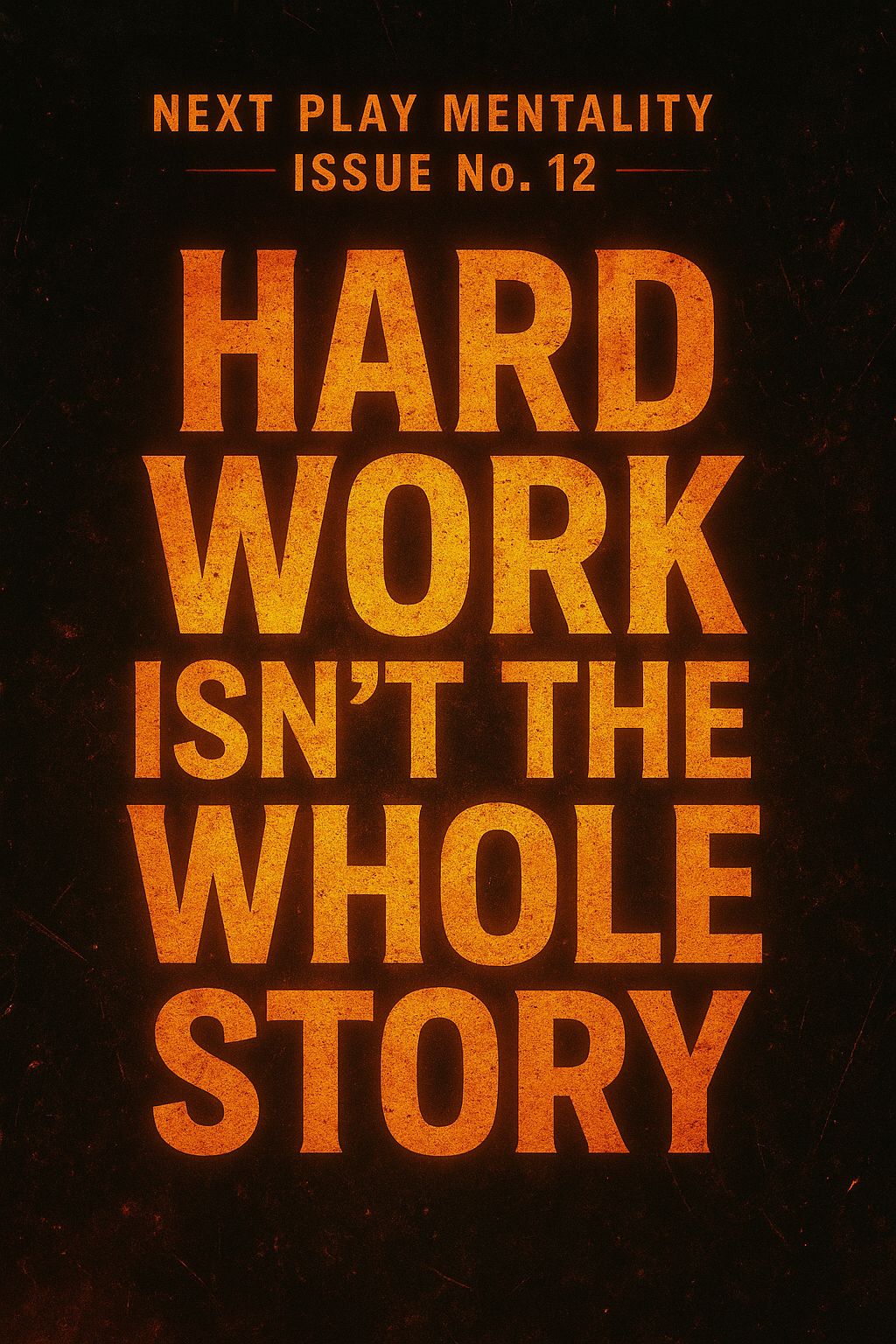
NEXT PLAY MENTALITY — ISSUE No. 12
Hard Work Isn’t the Whole Story
There’s a belief a lot of middle-school players carry into their 8th-grade year:
“If I work hard, everything will fall into place.”
And yes—effort matters. Discipline matters. Showing up matters.
But as players get closer to high school, they start to feel something they weren’t ready for:
Hard work alone stops separating you.
Everyone runs.
Everyone trains.
Everyone wants to impress the coaches.
Everyone wants to make varsity someday.
The game begins to reward the players who bring the things you can’t measure in reps and sweat.
This is where the story changes.
THE TRANSITION YEAR: HOW 8th GRADE REALLY WORKS
This is exactly what I’ve been telling Sebas.
“You can’t treat this year like middle school.
You have to treat it like preparation for who you need to be in high school.”
Not louder.
Not flashier.
Not more “look at me.”
More polished.
More aware.
More intentional.
DOMINATING MIDDLE SCHOOL ISN’T THE WHOLE STORY
A lot of kids dominate in middle school.
Size. Speed. Confidence. A green light on offense.
It looks impressive — for now.
But high-school coaches aren’t fooled by middle-school success.
They’re studying something deeper:
How do you behave when the game doesn’t go your way?
What happens to your body language when shots stop falling?
Do you pout, or do you problem-solve?
Are you about the team, or are you about yourself?
Do you calm your teammates, or do you add to the chaos?
Because dominating in middle school doesn’t guarantee you fit into a program that defines TEAM:
T – Together
E – Everyone
A – Achieves
M – More
Middle school rewards individual ability.
High school rewards players who elevate everyone around them.
And if you melt down in 8th grade when things get uncomfortable, you’ll melt down even faster when the lights get brighter.
The real separators aren’t the highlights.
They’re the habits you show under pressure.
That’s what coaches trust.
That’s what teammates follow.
That’s what earns real minutes when it matters.
THE VARSITY STANDARD (WITHOUT SAYING YOU’RE THERE YET)
The varsity environment isn’t something you wait to experience — it’s something you prepare for long before it arrives. Varsity basketball tests how you think, how you communicate, and how you steady yourself in moments that feel bigger than you. Coaches aren’t just evaluating talent; they’re evaluating maturity, awareness, and the habits you’ve built years before. You’re not claiming a varsity spot by acting this way. You’re building the foundation so that when you reach that level, you’re not surprised by the pace, the expectations, or the responsibility. You’re ready because you trained your mind first.
THE PARTS OF THE GAME HARD WORK WON’T COVER
1. Mental Processing
High school basketball moves faster — not physically, but mentally.
Psychology fact:
Players with higher “court processing speed” make correct decisions 2–3 seconds earlier than players who rely on instinct alone.
That two seconds decides games.
2. Emotional Stability
Mistakes get heavier.
Roles get clearer.
Competition sharpens.
High-school coaches don’t just watch your game —
they watch your reaction after something goes wrong.
Psychology fact:
Athletes who regulate emotion quickly perform better in the final minutes because their brain stays in “problem-solving mode,” not “fight-or-flight.”
Emotional control is trained just like footwork.
3. Leadership Without a Microphone
Leadership isn’t loud.
Leadership isn’t a speech.
Leadership is the way you carry yourself when nobody is watching:
Pointing out assignments.
Helping a teammate reset.
Keeping spacing clean.
Owning your mistake first.
Psychology fact:
Consistent leadership behaviors increase a player’s “trust rating” with coaches—even if their skill is equal to someone else’s.
Leadership isn’t a title.
It’s a presence.
THE SEASON BEFORE THE SEASON
I told Sebas this year is his rehearsal for high school:
“Don’t wait until next year to become the player next year will require.”
If he practices communication, composure, court vision, and body language now, he won’t be blindsided when expectations rise.
Hard work builds your body.
But the intangibles build your future.
FINAL WORD
Middle school is where effort gets you noticed.
High school is where everything else gets evaluated.
The players who move forward aren’t just the hardest workers.
They’re the ones who learn to think, communicate, settle themselves, and read the game like a version of themselves they haven’t reached yet.
Because at some point, every player realizes the truth:
Hard work isn’t the whole story.
Your mindset writes the chapters effort can’t.
— Coach Jason Garcia